On Utilising the Brain of the Group - The GSS Method
Group Decision Support Systems turn meetings into structured judgement. Bobbert and Mulder show how facilitation, anonymity, voting, and evidence capture help groups decide faster, fairer, and with stronger accountability.
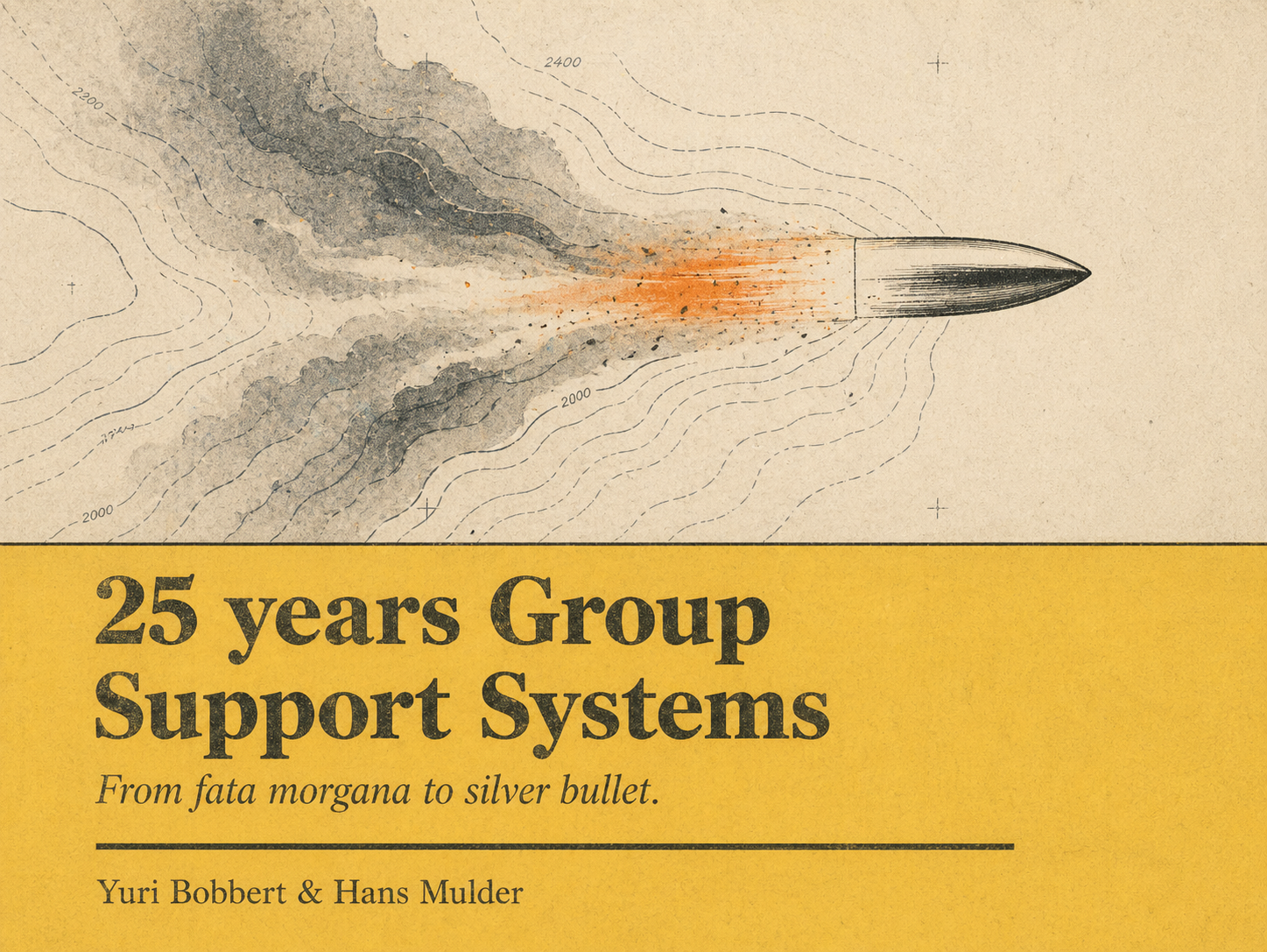
Meetings consume leadership time yet often dilute judgement. Y = Why: why gather people at altitude if dominance, vague goals, and weak evidence leave the group exposed?
Bobbert argues that Group Decision Support Systems turn meetings into structured decision processes. GSS lets participants generate ideas in parallel, organise them, vote, compare variance, and preserve the evidence trail. The value is not the software alone. It comes from clear objectives, a skilled facilitator, and agenda patterns that make equal participation possible.
The book shows GSS in education, police investigations, cybersecurity, agile development, risk analysis, and executive strategy. Reported benefits include 56% time savings in meeting preparation and follow-up, IBM research showing meetings up to 89% more effective with targeted additions, and GSS field evidence of 50% to 90% productivity or person-hour savings.
The authors also warn against treating GSS as automatic. Poor goals, weak process design, absent stakeholders, mistrusted anonymity, and inexperienced facilitation make bad meetings worse.
Three learnings and methodological approaches.
- Frame the session through Collaboration Engineering: define the objective, then sequence generate, reduce, specify, organise, evaluate, commit, and reflect.
- Use double-loop learning and relays to revisit the same data, compare perspectives, and test where consensus is real.
- Preserve the evidence trail with Design Science Research discipline: capture inputs, rankings, decisions, owners, and follow-up in the system.
The route. The method is a 25-year practice review combining GSS case studies, expert panels, design-science research, longitudinal data, and moderated sessions. Its lesson is plain: the route matters as much as the summit; process design, participant mix, and facilitation determine whether the group’s brain becomes usable.
Read the original — https://www.meetingwizard.nl/en/ebook